 Back
Back
IVAX
A Story About Mistakes (and why they are just as important as success)
The Problem
Researching vaccinations can be time-consuming and difficult. Even after adequate research, deciding whether to vaccinate your children or not can be even more of a struggle. With a myriad of clashing information online, people are too busy or too confused to review it all. Our team's goal was to provide a way for individuals, specifically parents, to educate themselves easily and quickly on vaccinations and to provide a platform where they could validate and build confidence in their healthcare decisions.
My Role
Although my classmates and I worked together throughout the entire design process, I mainly assumed the role of information architect, visual designer, and prototyper.
Ideation And Assumptions
My team and I began listing out all of our assumptions around vaccinations, people's views on them, and some concerns our users might have. From these initial assumptions we began listing out some questions:
What are some of the different views on vaccinations?
What sources do people trust when researching vaccinations?
Who do people often talk with when considering vaccinations for their children or even for themselves?
These were only a few of the questions we needed answered.
Survey
Based on our assumptions we built a survey with two main goals in mind; to identify our user target group and to understand their view on research and social interactions surrounding vaccinations. Because of the social climate surrounding vaccines, we knew that we would need to rely heavily on interviews to gather our information, so we kept the survey short.
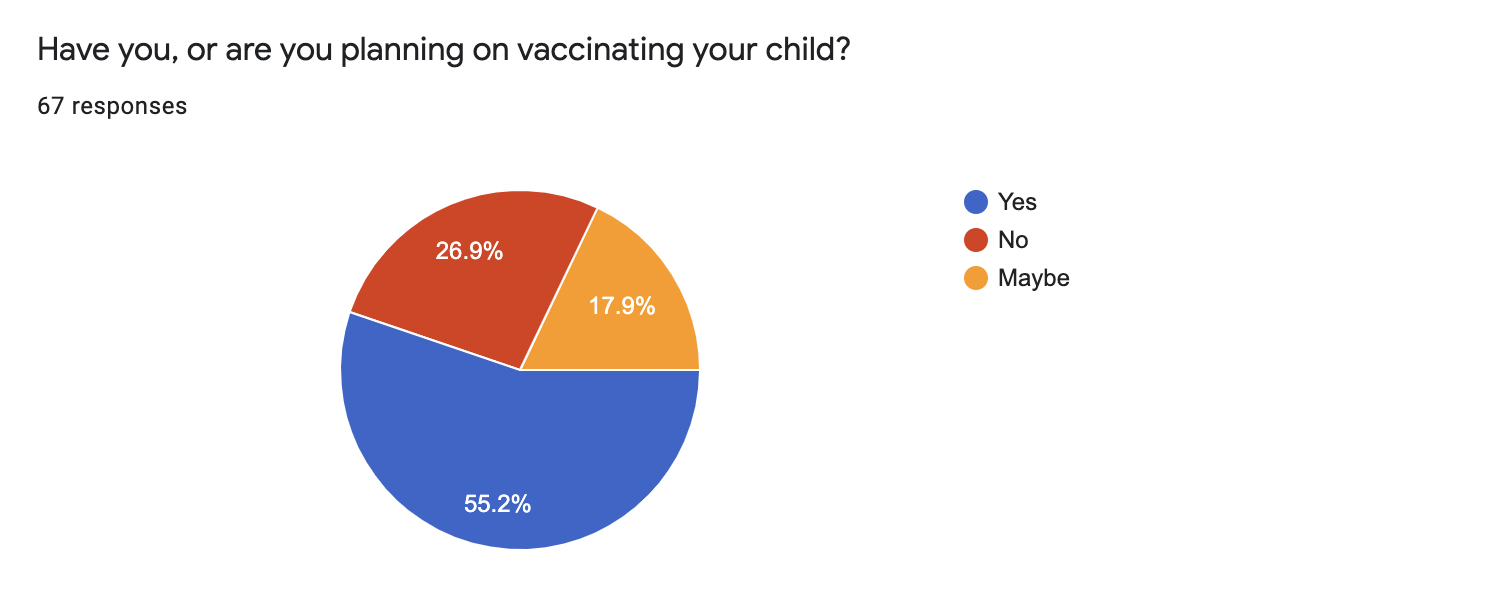
We needed to identify and confirm which target group our project was going to provide a solution for. While we wanted everyone to benefit from this, it was clear that there are two very polarized views concerning vaccinations. With this being a project, and the creative brief directing us to help others make better decisions about vaccinations, we assumed our target group would be new or expecting parents who are either planning to or considering vaccinations for their children. The survey confirmed this to be a valid assumption.
We wanted to identify if people were open to speaking more about their decisions and experiences with vaccinations. We assumed because of their previous interactions while sharing their views on social media or to friends, that it would be an overwhelmingly negative response. This assumption held partially true at 75% of people unwilling to speak more about vaccinations. Out of that 75%, only 4 individuals shared their contact information so we could contact them for an interview about vaccinations. This provided great insight into the user group and their reluctance to speak to their views or even their concerns about immunizations.
We had two questions that allowed for free form answers which provided some insight into what sources people trust or distrust. With the number of varying responses, we had to take some additional time to process this data through affinity mapping.
"There was an overwhelming amount of users who trusted their physicians, medical journals, and their intuition. These same users also greatly distrusted social media as a source for research and were critical towards the individuals sharing their content on it".
Affinity Mapping
Because of the vast amount of data we had to process and the two open-ended questions we involved in the survey, I suggested we gather the data into an affinity map. We began sorting our users' answers into common themes (concerns, frustrations, insight to current user activity, insecurities, etc). From these common themes we began building insight statements like "I trust my doctor to teach me about vaccinations", "Social media is not a good tool to use for research, but I still search on it here and there", and "There is just too much data available online with no sources listed for their claims". These insight and problem statements began painting the picture of what our users valued and what they did not.
There was an overwhelming amount of users who trusted their physicians, medical journals, and their intuition. These same users also greatly distrusted social media as a source for research and were critical towards the individuals sharing their content on it.
Users felt deeply about this topic, and our findings reflected the majority of our users thought it was too difficult to validate information on social media. Even so, users would bring up a desire to speak to others openly about vaccinations without starting heated conversations in the comments section on Facebook or Instagram.
Interviews
We were able to interview a handful of people who fell into our user target group. Based on the insights derived from our initial data, I suggested we focus our interviews heavily on how people felt about social media as a tool for medical research and communication, how family and society influence our users' decisions, and how our users have researched vaccinations in the past. We also focused on how individuals research vaccinations for themselves and their children, what tools or platforms are currently being used, how people measured the confidence of their decisions, and how easy researching about vaccines was in the current state. Although we knew our users didn't see social media as a viable research platform, we had a strong common theme in our affinity map that suggested that individuals needed a social platform that was moderated, safe, and possibly anonymous. We wanted to better understand what about social media made it an undesirable research tool, and what kind of interaction our users were looking for.
People trust their doctors but struggle to make decisions about vaccinations without having some research conducted of their own. The interviews informed that users trust their doctors, but they didn't know what questions to ask. People rely on doctors to build confidence in their decisions but often had issues remaining confident once confronted by others about their decisions.
Social media was not a valid source of information because of the lack of supervision, accountability, and citations for people's claims. Despite this overwhelming attitude, our users still had a desire to plug into a community of like-minded parents on a social platform so they can hear real parents' stories and have a somewhat "judgment-free" zone where they can safely challenge and validate their views.
Vaccination research was mainly a passive activity for our users. Since they trusted their doctors and didn't want to spend the time reading endless medical journals online, they opted to take their doctor's word for it. Users often communicated a sense of a lack of understanding because of this, which made them somewhat uncomfortable when asked to support or explain their views to others.
"Despite this overwhelming attitude, our users still had a desire to plug into a community of like-minded parents on a social platform so they can hear real parents' stories and have a somewhat "judgment-free" zone where they can safely challenge and validate their views".
Empathy Mapping
With our previous user insights in mind, and our interview notes and recordings, I used an empathy map to better understand the frustrations our users were facing. We formulated four distinct user statements:
"I trust my doctors, but I wish I knew more so I could have an actual conversation with them"
"I feel overwhelmed when searching about vaccinations online"
"I want to protect my children and my community, but I have some concerns about vaccinations".
"Social media can't be trusted with medical research, but I like to talk to other parents to hear their stories and views while I form my own".
Persona
Our persona, Michelle Summers is a mother who feels confident in her decisions about vaccinating her children. But when faced with opposition or questions about her decisions, she loses that sense of confidence. She trusts her doctor to share accurate information regarding vaccines, but she wishes her conversations had more structure so that she could better communicate to her friends and family. Her goal is to protect her children, her family, and her community. Even after her doctor's input, she still wants to research more before vaccinating another child again. With our user persona in mind, we began to ideate.
Ideation And Story Mapping
"To 'gamify' a healthcare decision would imply our users are incapable of caring for their well-being and would cheapen our product and distract from the needs of our users".
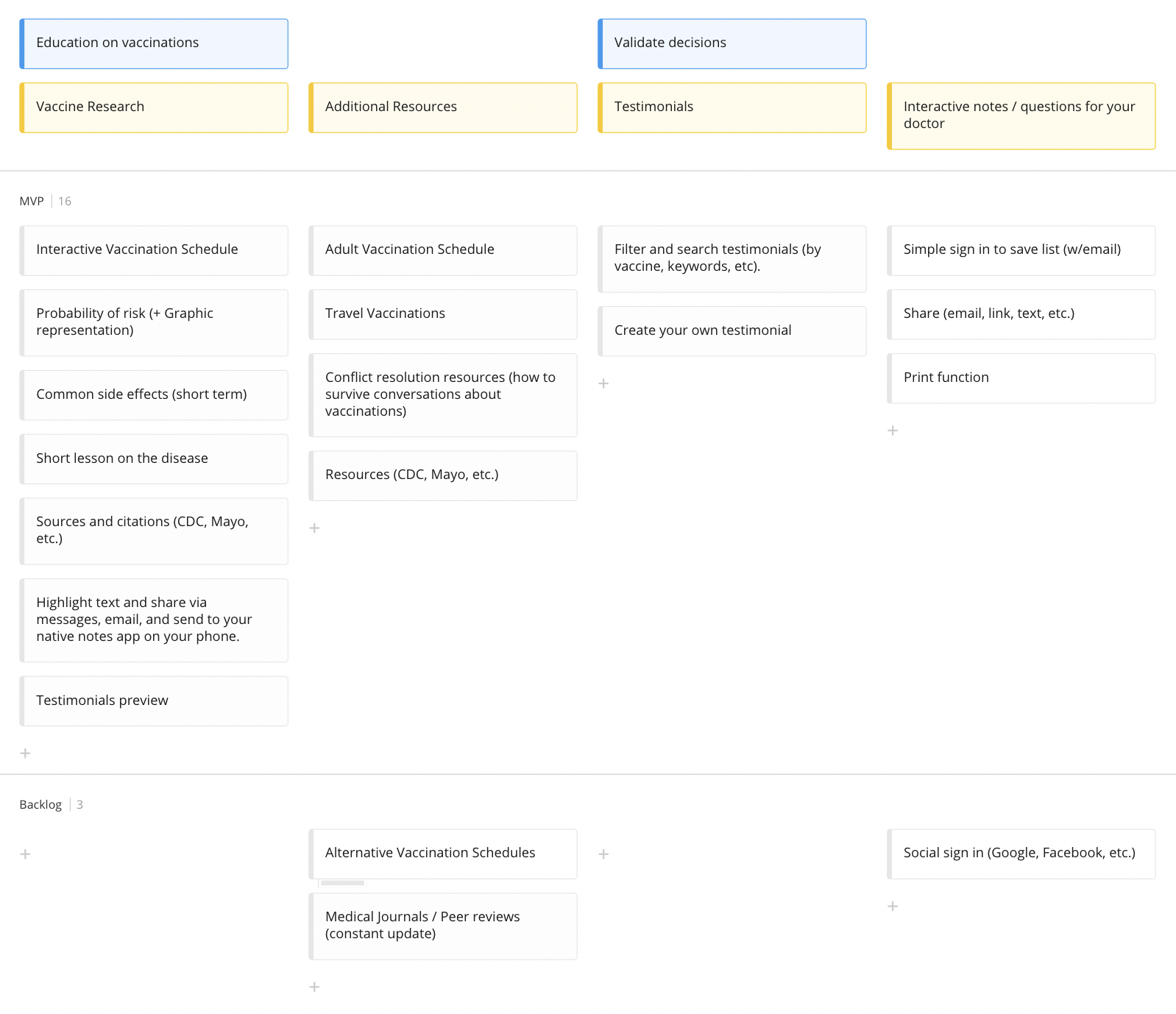
Because of the social climate of today's conversations around vaccinations and privacy, we decided to avoid gamification. We agreed that to "gamify" a healthcare decision would imply our users are incapable of caring for their well-being and would cheapen our product and distract from the needs of our users. It was clear that our users already had the motivation to research vaccinations. What they wanted was access to the tools to carry research out the way they would like to - quickly and without pressure.
Steering away from any kind of motivation creating features, our Ideas focused more on allowing the user to feel comfortable digesting vaccination research data quickly. Ideas included basic social forums, doctor-user Q&A, physician profiles, and even conflict resolution help when dealing with strong-willed friends and family.
Our team settled on a simple interface that had three main functions: a vaccine research page that allowed mothers and fathers to quickly research a vaccine while at the doctor's office or on a work break, a notes function that would create a list of citations and/or questions a user could bring to their doctor at their next appointment and a limited social interaction where user stories about vaccinations could be shared.
These features addressed two goals our persona had when using our product: To educate herself on vaccinations and immunizations and to build confidence in and validate her decisions.
Wireframing
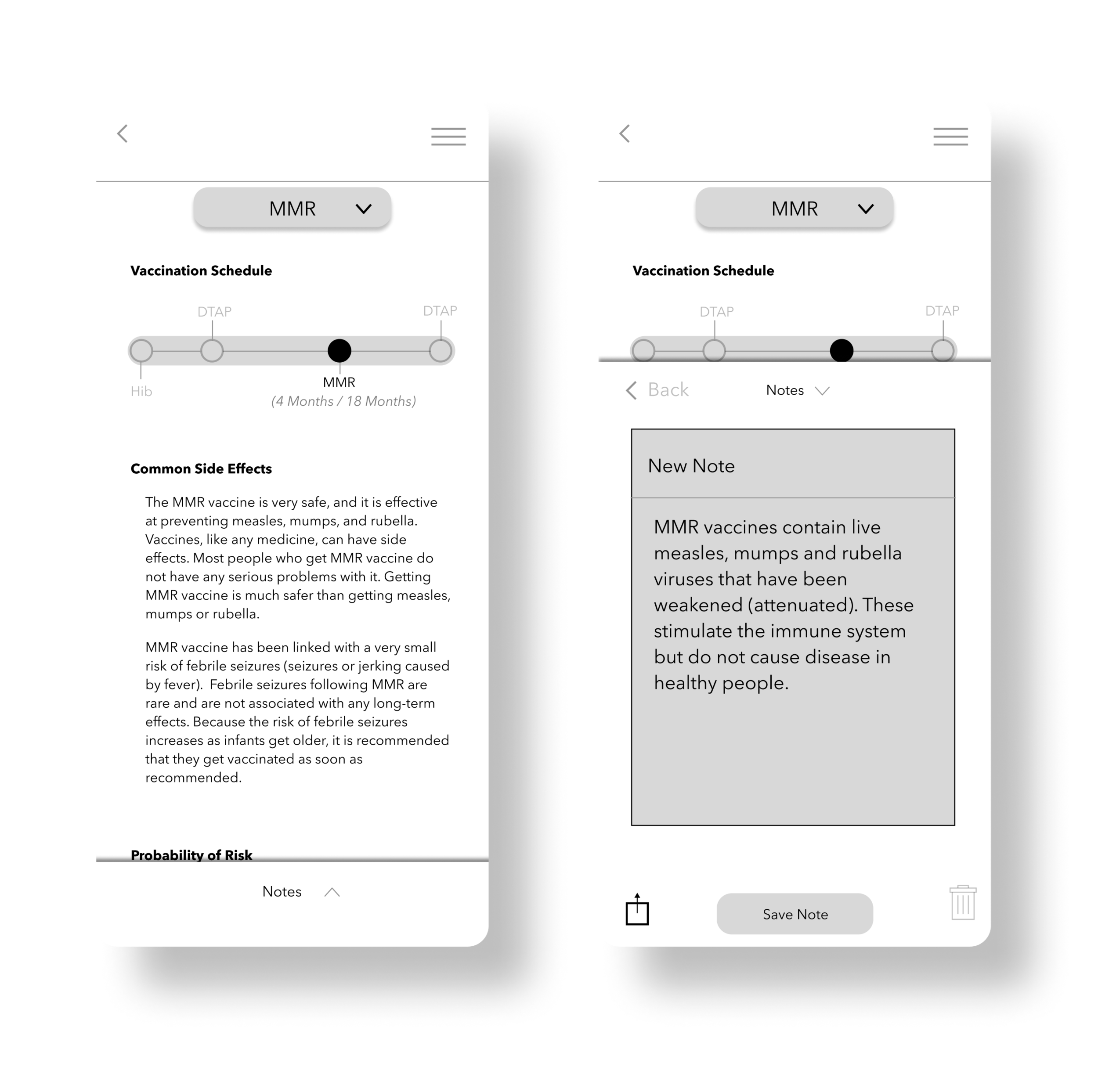
The interface needed to be very clean, simple, easy to use, and responsive in design. It was at this stage we determined two things that were essential for our product:
The user needed to be able to research vaccinations quickly. We tossed around the idea of a research page that, when a vaccine was selected from a drop-down, would repopulate pre-determined informational sections with the appropriate data. This would ensure a quick and easy way to research something that can be confusing and complicated.
An overwhelming amount of our users trusted their doctors but wanted to have more meaningful conversations. To help facilitate this, we sketched out an interactive notes tab that would appear static throughout our entire website that could easily be opened and edited to build either a list of questions or talking points that the user could then bring with them to their appointment. User data suggested this to be a necessary function.
Usability Testing And Feedback
The majority of our usability test was focused on navigation, note-taking, and researching vaccinations on our website.
Once we completed usability tests, we came to a clear conclusion that our static notes tab was a distraction to the user. It was apparent that they would use their phones or computers native note-taking applications, rather than one on a webpage. Users thought it was difficult to use and that it didn't fit in with the rest of the product. The tab on our site simply confused the users and cluttered their screens. Removing the notes function forced us to shift our focus to providing more social interaction. Our research confirmed our assumptions that social media is used sparingly in research because users can't trust the content shared on it. However, users had a desire to connect with other people on a topic that often leads to heated conversations and, as one user put it "comment wars". Some of our earlier insight statements support this:
"Social media has its place, it can lead you in different directions, but you need to research the sources on your own".
"I often want to know what other mothers think about vaccinations but conversations on social media are a little too heated for me".
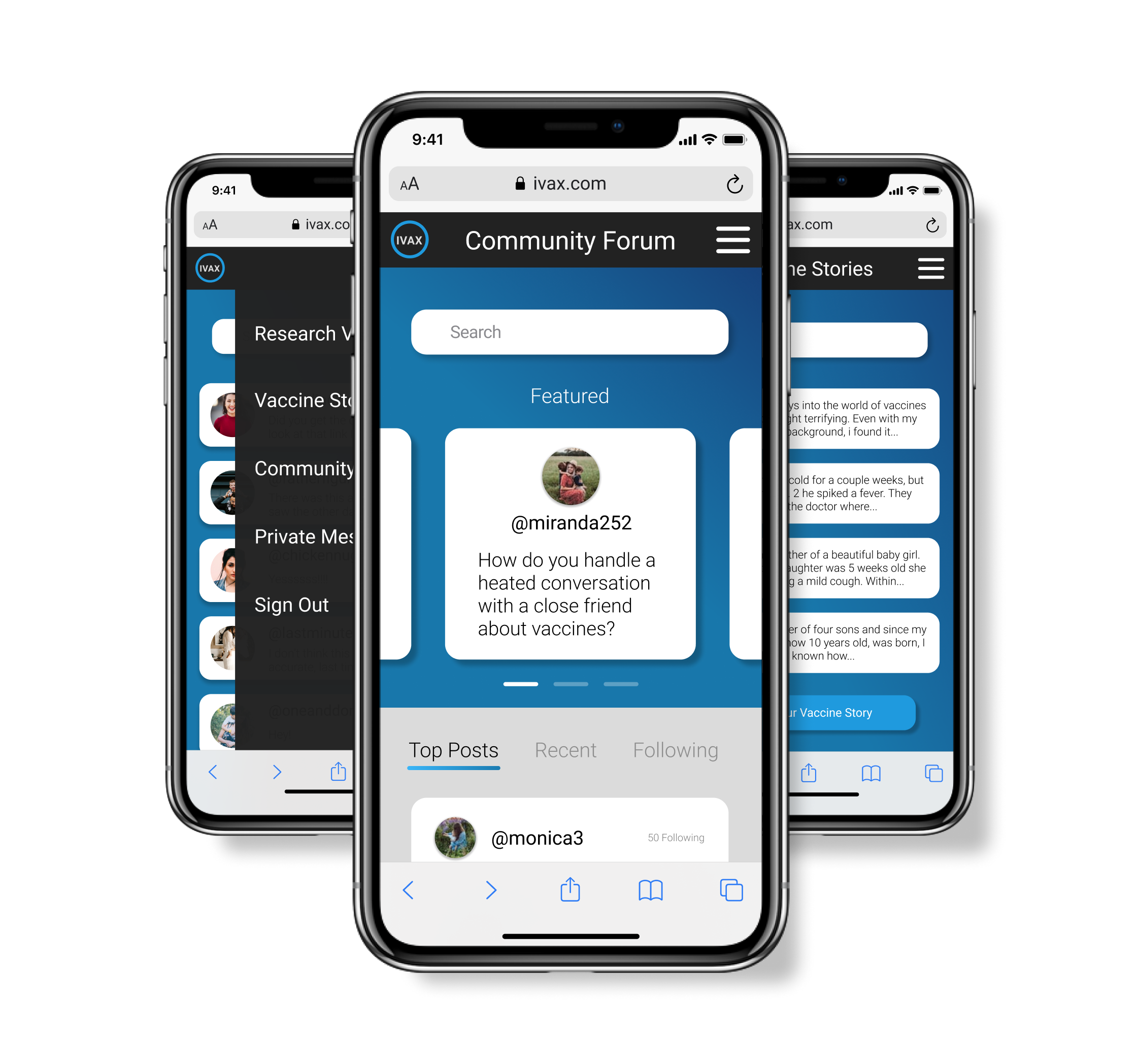
Our "Q&A" board, alongside a testimonials page, would allow users to interact in an environment where real stories can be shared about vaccinations, and where users can post questions and requests for additional resources or links.
Some functional insights derived from our user testing:
Drop-down selections and buttons weren't obvious to the user. Our initial mid-fidelity prototypes lacked consistency and adequate contrast for interactive buttons and menus.
We addressed this by creating consistency for our interactive elements across the webpage. Although a simple fix, our users' conceptual models of how to utilize the interface were greatly aligned to the actual functions provided within it.
Navigation wasn't cohesive but seemed disconnected and confusing. Our prototypes had a menu bar in the top right corner for page links, back buttons on some pages but not all, and a lack of affordance for navigation since it felt like an application, but lived in a browser.
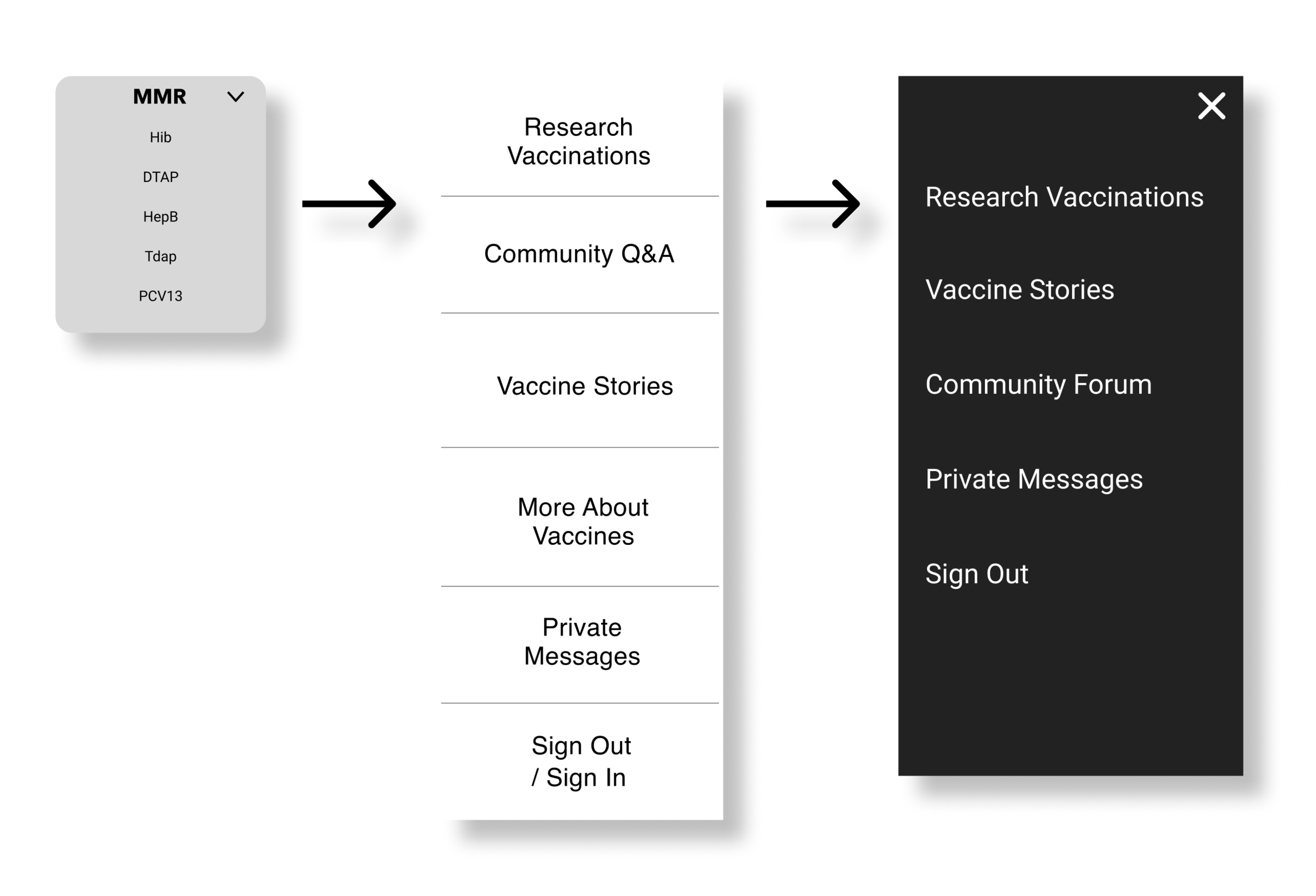
Our approach to solving this issue was simple "less is more". Instead of trying to reinvent the wheel, we settled on a typical hamburger menu to signify navigation and removed additional elements that simulated a native application. This was well received in our final tests and proved beneficial for the users' understanding of the navigation.
Project Debrief
Some follow-up items would have to be addressed given more time and resources.
We would need to test the research page to make sure it is quick to use and easy to read for the user. I am a fan of visual communication, so building out a consistent, visual approach to outlining vaccination information would be an important step moving forward in the process.
We would have to test the social functions to make sure vernacular makes sense for the user and that the buttons are well placed since this function was built after the notes function was removed.
Shout out to a Figma community resource - iOS/iPhone Browser Frame - Chrome & Safari.

